
SAMPLING
Sampling System for Liquids
DIN-EN: DN 15 – 100 / PN 10 – 40
ASME: NPS ½“ – 4“ / class 150 – 300
PT range: -40 < T < 230°C, vacuum 10-8 mbar
Download

Design Features
Design Characteristics
- closed system
- cavity free
- spilling eliminated and contamination free
- specific defined representative sample quantity
- pressure free sampling (positive overlap)
- simple and fool safe operation
- absolutely tight
- utility model
- fugitive emmission resp. clean air act certified (TA – Luft 2002 approval)
- Directive 2014/68/EU

Standard Design
| Standard Design | TYPE A | TYPE B |
|---|---|---|
| application | for high-toxic liquid media | for less toxic resp. polluted media |
| bottle connection | needle system and bottle protection | PTFE-adaptor |
| sample bottles | clear glass or SCHOTT-DURAN labaratory bottle with ISO-thread | clear glass or SCHOTT-DURAN labaratory bottle with ISO-thread |
| bottle volume(VF) | 60, 100, 250, 500 ml | 60, 100, 250, 500 ml |
| standard diaphragm (Septum) | rubber/ PTFE | – |
| temperature (Tmax) | 230°C | 230°C |
| Needle diameter | 2, 4, 6 mm | 6, 8, 10, 15 mm |
Bottle connection
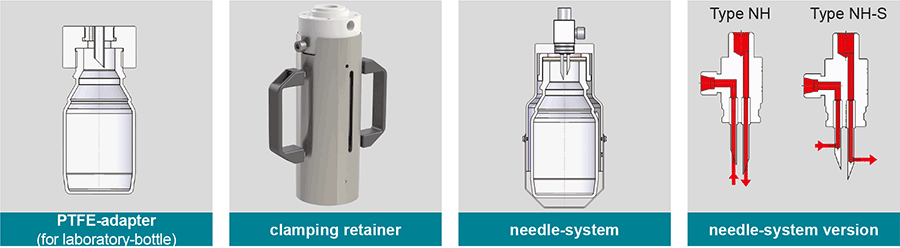
- PTFE-Adapter: for laboratory bottle with ISO-thread GL 32/45. Application: For less toxic resp. polluted media.
- Clamping Retainer: For fast and easy exchange of laboratory bottle, even for heated version.
- Needle system: closed needle system for laboratory bottle with septum (Butyl and PTFE). Needle System NH and NH-S with diverse internal diameter(2-6 mm). Application for high toxic resp. polluted media for spillnig eliminated an contamination free sampling.
PT-Diagram

Operating temperatures < -30°C and > 220 °C have to be checked and approved by AZ according to the operating conditions.
Besides the P/T value of the sleeve the limitations of the valve bodies also have to be considered. Please refer to the EN 12516-1 resp. ASME B16.34 in order to choose a proper pressure rating (PN/class). The shown values refer to austenitic stainless steel 1.4408 (A351 Gr. CF8M).
1) For operating temperatures below -10°C low temperature / austenitic steels are required.
2) Sleeve: There are different sleeve materials / compounds available.
Materials
Standard body materials
- Carbon Steel 1.0619, ASTM A216 WCB
- Stainless Steel 1.4408, ASTM A351 CF8M
- Stainless Steel 1.4308, ASTM A351 CF8
- Unalloyed stainless steel casting (low Temp.) 1.1138, LCC/LCB/A352
Standard plug materials
• Stainless Steel 1.4408, ASTM A351 CF8M
• Stainless Steel 1.4308, ASTM A351 CF8
Special materials
• Alloy
• Monel
• Nickel
• Zirconium
• Titan
• Tantal
• other materials on request
Lining materials(TRF + TRF-A)
• PFA, PFA-conductive, FEP
Sealing Systems
Type STD
Standard sealing for all major applications;
Tmax 230°C

Type FS
Firesafe sealing (API 607) with graphite packing for additional
stem sealing; Tmax 230°C

Type CA
Chemical sealing to prevent fugitive emission of aggressive and toxic media
with PTFE packing for additional stem sealing; Tmax 230°C

Type FSN
Firesafe safety sealing (API 607) for fluctuating temperatures
with 3x graphite packing (adjustable) for additional
stem sealing; Tmax 280°C

Type FSN-SL
Firesafe safety sealing (API 607) for fluctuating temperatures
with 3x graphite packing (live loaded disc springs) for additional
stem sealing; Tmax 280°C

Type CASN
Chemical safety sealing for fluctuating temperatures
with 3x PTFE packing (adjustment) for additional stem sealing;
Tmax 230°C

Type CASN-SL
Chemical safety sealing for fluctuation temperatures
with 3x PTFE packing (live loaded disc springs) for additional
stem sealing; Tmax 230°C

Port Forms

Dimensions

Actuation
1 Locking Devices
Pilot valve combinations, pad lock eyelets, linear key conception, indexing plunger arrestor.
2 Actuators
Actuators for mounting-flange acc. to DIN ISO 5211
3 Cover extension
Solid construction in stainless steel, Standard extension 100 mm or 150 mm high, non standard lengths are available on request . Hexagonal bolts on adjustment ring freely accessible. Note: Don’t use with sealing FSN/FSN-SL and CASN/CASN-SL
